AI-Powered Phishing Detection: Slashing Cloud Security Breaches
Advertisements

Artificial intelligence (AI) is fundamentally reshaping cybersecurity defenses, particularly in the realm of phishing detection, by offering unprecedented capabilities to identify and neutralize threats that traditional methods often miss.
In an era where cyber threats evolve at an alarming pace, the fight against phishing has become a critical frontier for organizations worldwide. The promise of AI-Powered Phishing Detection: 4 Critical Tools Slashing Cloud Security Breaches by 60% isn't just a bold claim; it's a testament to the transformative power of artificial intelligence in safeguarding our digital ecosystems. This article delves into how AI is redefining security, offering a robust defense against increasingly sophisticated attacks that target cloud infrastructure.
The escalating threat of cloud phishing attacks
Cloud environments, while offering unparalleled flexibility and scalability, have also become prime targets for cybercriminals. The migration of sensitive data and critical applications to the cloud has unfortunately expanded the attack surface, making organizations more vulnerable to sophisticated phishing campaigns.
Traditional security measures, often reliant on signature-based detection and human vigilance, are struggling to keep pace with the ingenuity of threat actors. Phishing attacks have grown more personalized and deceptive, often bypassing standard email filters and user education. This necessitates a more dynamic and intelligent defense mechanism.
Why traditional methods fall short
Signature-based detection, while effective against known threats, is inherently reactive. It can only identify attacks that have been previously cataloged. Zero-day phishing attacks, which exploit unknown vulnerabilities, can easily slip through these defenses. Furthermore, the sheer volume of emails and digital communications makes it impossible for human security teams to manually scrutinize every potential threat.
- Static Rules: Traditional systems often rely on predefined rules that are easily circumvented by polymorphic and evasive phishing techniques.
- Human Error: Employees remain the weakest link, susceptible to cleverly crafted social engineering tactics that exploit trust and urgency.
- Volume Overload: The massive scale of digital communication overwhelms manual review processes, leading to missed threats.
The limitations of these conventional approaches underscore the urgent need for a paradigm shift in how we detect and prevent phishing. The financial and reputational costs of a successful breach are astronomical, driving the imperative for more proactive and intelligent security solutions.
Understanding the inadequacy of past methods is crucial for appreciating the revolutionary potential of AI in this domain. As cybercriminals refine their tactics, so too must our defenses, moving towards systems that can predict and adapt rather than merely react.
How AI revolutionizes phishing detection
Artificial intelligence brings a new level of sophistication to phishing detection by moving beyond static rules and signature matching. AI-powered systems leverage machine learning algorithms to analyze vast amounts of data, identify complex patterns, and predict potential threats with remarkable accuracy.
Unlike human analysts or rule-based systems, AI can learn and adapt from new data, continuously improving its ability to differentiate legitimate communications from malicious ones. This proactive capability is what makes AI an indispensable tool in today's cybersecurity landscape.
Machine learning for threat identification
Machine learning models are trained on massive datasets of both legitimate and phishing emails, websites, and other digital communications. These models learn to recognize subtle indicators of malicious intent that would be imperceptible to humans or traditional filters.
- Behavioral Analysis: AI can analyze user behavior and network traffic patterns to detect anomalies that may indicate a phishing attempt.
- Natural Language Processing (NLP): NLP allows AI to understand the context, sentiment, and linguistic nuances of emails, identifying suspicious phrasing or unusual requests.
- Image Recognition: AI can analyze embedded images and logos for signs of spoofing or manipulation, a common tactic in sophisticated phishing campaigns.
The ability of AI to process and interpret diverse data points across multiple vectors provides a holistic view of potential threats. This multi-layered analysis significantly enhances the chances of detecting even highly evasive phishing attempts before they can cause harm.
By constantly learning from new attack vectors and evolving threat landscapes, AI-driven solutions offer a dynamic defense that can keep pace with the ever-changing tactics of cybercriminals. This adaptability is a key factor in their success in reducing breach rates.
Tool 1: Advanced Email Gateway Solutions with AI
One of the most critical front lines in phishing defense is the email gateway. Modern advanced email gateway solutions are no longer just simple spam filters; they are sophisticated platforms integrating AI and machine learning to provide robust, real-time protection against a wide array of email-borne threats.
These AI-powered gateways meticulously examine every incoming and outgoing email, scrutinizing headers, content, attachments, and embedded links for any indicators of compromise. They can effectively block malicious emails before they even reach an employee's inbox, significantly reducing exposure.
Real-time threat intelligence and sandboxing
AI-driven email gateways integrate with global threat intelligence feeds, allowing them to identify and block known malicious URLs and sender domains instantly. Beyond this, they employ dynamic sandboxing techniques to analyze suspicious attachments and links in a secure, isolated environment.
- URL Rewriting and Analysis: All URLs in emails are rewritten and analyzed in real-time, checking against blacklists and performing dynamic analysis for malicious redirects.
- Attachment Sandboxing: Suspicious attachments are executed in a virtual environment to observe their behavior without risking the corporate network.
- Impersonation Detection: AI models are trained to detect executive impersonation and brand spoofing, common tactics in targeted phishing.
The effectiveness of these tools lies in their ability to combine multiple detection techniques, from static analysis to behavioral profiling, all orchestrated by intelligent AI algorithms. This comprehensive approach ensures that even the most cunning phishing attempts are identified and neutralized.
By acting as the first line of defense, advanced email gateways with AI capabilities are instrumental in preventing a vast majority of phishing attacks from ever reaching end-users, thereby protecting organizations from significant financial and reputational damage.
Tool 2: Endpoint Detection and Response (EDR) with AI
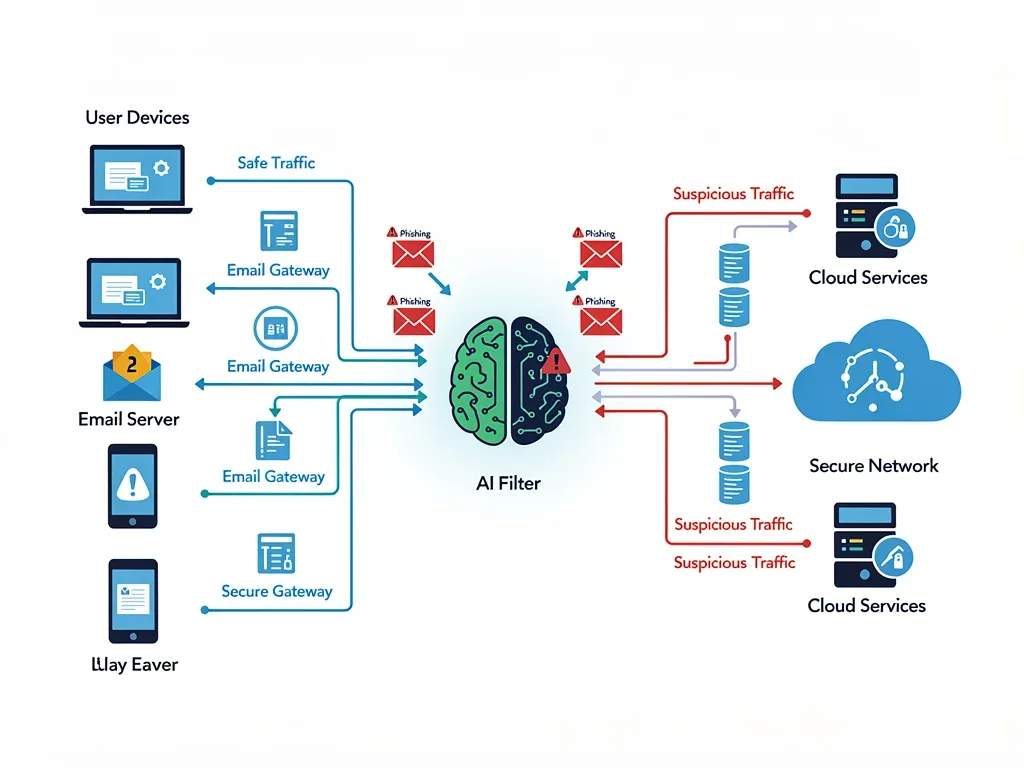
While email gateways protect the perimeter, endpoint detection and response (EDR) solutions with AI capabilities provide crucial defense at the user device level. Even if a phishing email bypasses the gateway, EDR acts as a safety net, monitoring endpoint activity for signs of compromise.
AI-powered EDR continuously collects and analyzes data from endpoints, including process activity, file changes, network connections, and user actions. This granular visibility allows it to detect anomalous behaviors that might indicate a successful phishing attempt or subsequent malware infection.
Behavioral anomaly detection
The core strength of AI in EDR is its ability to establish a baseline of normal user and system behavior. Any deviation from this baseline, such as unusual file access, unauthorized process execution, or suspicious network communication, triggers an alert.
- Malware Detection: AI can identify new and polymorphic malware strains that might be delivered via phishing, based on their behavior rather than signatures.
- Ransomware Protection: EDR with AI can detect and prevent ransomware activities, such as mass file encryption, often initiated after a successful phishing attack.
- Insider Threat Detection: By monitoring user behavior, AI can also flag potential insider threats that might be exploited through sophisticated phishing.
The real-time monitoring and analytical capabilities of AI-driven EDR allow security teams to quickly identify, investigate, and respond to threats. This significantly reduces the dwell time of attackers within a network, minimizing the potential impact of a breach.
Integrating EDR with AI provides a critical layer of defense that complements gateway protection. It ensures that even if an initial phishing vector succeeds, the subsequent malicious activities are detected and contained before they can escalate into a full-blown security incident.
Tool 3: Security Information and Event Management (SIEM) with AI
Security Information and Event Management (SIEM) systems are foundational for comprehensive cybersecurity, and their integration with AI has dramatically enhanced their ability to detect and respond to complex threats, including multi-stage phishing campaigns. AI-powered SIEMs aggregate and analyze security data from across the entire IT infrastructure.
This includes logs from firewalls, servers, endpoints, applications, and cloud services. By applying machine learning to this massive influx of data, SIEMs can correlate seemingly disparate events, identify patterns indicative of advanced persistent threats, and provide actionable insights to security teams.
Automated threat correlation and prioritization
One of the biggest challenges in security operations is sifting through countless alerts. AI in SIEM automates this process, using advanced algorithms to correlate events and prioritize those that represent genuine threats, often uncovering sophisticated phishing attacks that evolve over time.
- Contextual Analysis: AI provides context to alerts, understanding the relationship between different events to form a complete picture of an attack.
- Reduced False Positives: By learning from past alerts and user feedback, AI helps to reduce the number of false positives, allowing security analysts to focus on real threats.
- Proactive Threat Hunting: AI can assist in proactive threat hunting by identifying subtle indicators of compromise that might otherwise go unnoticed.
The ability of AI-driven SIEM to synthesize information from diverse sources and identify hidden attack narratives is crucial for detecting complex phishing schemes that involve multiple steps and exploit various vulnerabilities across an organization's digital footprint.
By transforming raw security data into intelligence, AI-powered SIEMs empower security teams to respond more effectively and efficiently, strengthening the overall security posture against evolving phishing threats. This centralized visibility is indispensable for modern cloud security.
Tool 4: Cloud Access Security Brokers (CASB) with AI
As organizations increasingly rely on cloud services, Cloud Access Security Brokers (CASBs) have become essential. When integrated with AI, CASBs provide critical visibility and control over cloud usage, helping to prevent data exfiltration and unauthorized access often initiated through successful phishing attacks.
AI-powered CASBs monitor user activity across sanctioned and unsanctioned cloud applications, detecting suspicious behaviors, enforcing data loss prevention (DLP) policies, and identifying shadow IT. They act as an enforcement point between users and cloud service providers.

User and entity behavior analytics (UEBA) for cloud security
A key AI capability within CASBs is User and Entity Behavior Analytics (UEBA). UEBA uses machine learning to profile typical user behavior within cloud environments. Any deviation from this learned baseline, such as unusual login times, access from new locations, or abnormal data downloads, triggers alerts.
- Data Loss Prevention (DLP): AI-enhanced CASBs can identify and prevent sensitive data from being uploaded to unauthorized cloud services, often a consequence of phishing.
- Compliance Enforcement: They ensure that cloud usage adheres to regulatory compliance standards, reducing legal and financial risks.
- Threat Protection: CASBs can detect and block malware embedded in cloud files, preventing the spread of threats originating from phishing.
The comprehensive visibility and granular control offered by AI-powered CASBs are vital for securing cloud-centric organizations against phishing-related threats. They ensure that even if credentials are compromised, the scope of potential damage is significantly limited.
By providing a robust security layer specifically designed for the cloud, CASBs with AI capabilities are instrumental in maintaining data integrity and confidentiality in dynamic cloud environments, making them a cornerstone of modern cloud security strategies.
| Key Tool | Primary Benefit in Phishing Detection |
|---|---|
| Advanced Email Gateways | Blocks malicious emails before reaching inboxes, using real-time analysis and sandboxing. |
| Endpoint Detection & Response (EDR) | Monitors endpoint activity for anomalies, detecting post-phishing malware and compromise. |
| Security Information & Event Management (SIEM) | Correlates security data across the infrastructure to identify complex, multi-stage phishing campaigns. |
| Cloud Access Security Brokers (CASB) | Provides visibility and control over cloud usage, preventing data exfiltration and unauthorized access. |
Frequently Asked Questions About AI Phishing Detection
What is AI-powered phishing detection?▼AI-powered phishing detection uses artificial intelligence and machine learning algorithms to analyze various data points, identify patterns, and proactively detect and prevent phishing attacks. It goes beyond traditional methods by adapting to new threats and recognizing subtle indicators of malicious intent.
How does AI improve cloud security against phishing?▼AI enhances cloud security by providing real-time threat intelligence, behavioral anomaly detection, and automated correlation of events across diverse cloud services. This allows for faster identification and mitigation of phishing attempts targeting cloud environments, significantly reducing breach risks.
What are the main benefits of using AI for phishing detection?▼Key benefits include a significant reduction in successful phishing attacks, improved detection of zero-day threats, lower false-positive rates, faster response times, and enhanced protection for sensitive data. AI's adaptability means it continuously learns and evolves with new attack vectors.
Can AI-powered tools completely eliminate phishing?▼While AI-powered tools dramatically reduce the success rate of phishing attacks, complete elimination is challenging due to the constant evolution of cyber threats and the human element. They form a crucial part of a multi-layered security strategy, but vigilance and user education remain important.
How do these AI tools integrate into existing security infrastructures?▼Many AI-powered phishing detection tools are designed for seamless integration. Advanced Email Gateways sit at the network edge, EDR agents deploy on endpoints, SIEM aggregates logs from all sources, and CASBs integrate with cloud services, all working together to form a cohesive defense.
Conclusion
The landscape of cyber threats is continuously evolving, with phishing attacks becoming increasingly sophisticated and targeted, especially within cloud environments. The adoption of AI-powered phishing detection tools is no longer a luxury but a necessity for organizations aiming to secure their digital assets and maintain operational integrity. By leveraging the advanced capabilities of AI in areas like email gateway protection, endpoint detection, security information management, and cloud access security, businesses can build a robust, adaptive defense against these pervasive threats. The evidence suggests that such integrated AI solutions are not only effective but are critical in significantly slashing cloud security breaches. As we move forward, the strategic implementation and continuous refinement of AI in cybersecurity will be paramount to staying ahead of cybercriminals and protecting our increasingly cloud-dependent world.
